Your Guide to Becoming an AI Champion at Work

The Unparalleled Opportunity for New Professionals
In today's workplace, a new and powerful leadership role is emerging: the AI Champion. This isn't a formal title handed down from management, but a role you can seize through pure initiative. It's about being the person on your team who sees the transformative potential of artificial intelligence and takes the first step to help everyone else see it, too.
For professionals, this is a rare and transient opportunity. This unique window for an individual contributor to have such outsized impact is specific to this technological shift and won't last forever. By becoming the person who "raises their hand" to lead your team's AI adoption, you can gain visibility, influence strategy, and accelerate your career in ways that are typically reserved for senior leaders. This guide provides a step-by-step playbook, based on real-world experience, for how you can become that champion.
The Spark: From Personal Discovery to Professional Vision
The journey to becoming an AI champion almost always begins with a personal "Aha!" moment, a profound experience where an AI tool helps you achieve something that just "blows you away."
Describe the "Aha!" Moment This often happens outside of work, while exploring a passion. For Brian Greenbaum, a product designer at Pendo, it happened while he was on paternity leave (check out his YouTube about it - how I heard his story https://www.youtube.com/watch?v=yaG70VotukE). A self-described tech geek, he was jealous of friends who had record collections and missed the tactile experience of flipping through albums. He had an idea: what if he could create a mobile music player app that played Spotify albums by scanning QR codes on laminated cards? Though not an active developer, he tried Cursor. Within a couple of hours, he had a working prototype. The experience of creating something so functional so quickly was profound.
Connect the Spark to Your Day Job The next step is to translate that personal excitement into a professional application. The same tool that helped build a hobby app could be used at work to create more dynamic, interactive prototypes for new features. For a designer working on data-heavy analytics products, where static Figma mockups often fall short, this was a game-changer.
Formulate Your Core Idea This process culminates in a clear vision: you've identified a new technology, you've seen its power firsthand, and you can articulate exactly how it can help your team and your company be more successful.
This initial, personal realization is the fuel for your entire initiative. But an idea is only powerful if it's shared, which requires you to take a proactive leap.
Taking the Leap: How to Share Your Vision Effectively
Once you have your core idea, the most crucial step is to proactively share it with managers and leadership. Your goal is not just to talk about a cool new tool (the "what"), but to communicate the strategic impact it could have (the "why"). This single act of communication is often the first step toward gaining executive visibility.
Crafting Your Message
When you reach out, frame your message around two distinct but complementary goals. This shows you're thinking not just about your own productivity, but about the broader success of the team and the company.
Goal 1: Internal Empowerment Focus on upskilling the entire team, including product managers, designers, and others to leverage new AI tools. Emphasize the concrete benefits this will bring, such as the ability to:
Get more done in fewer hours.
Improve decision-making with better data and prototypes.
Communicate and validate ideas more effectively.
Goal 2: External Leadership Frame the initiative as an opportunity for the company to position itself as a thought leader in its industry. By embracing AI early and openly, the company demonstrates innovation and can better serve its own customers who are going through a similar transformation.
Offer to Lead
The most powerful part of your message is your offer to take ownership. You aren't just presenting an idea; you're volunteering to lead the charge.
I'd like to lead a cross-functional product team with designers, PMs, etc. with two goals in mind...
This single sentence transforms you from a curious employee into a potential leader. The impact can be immediate. After Brian sent his message, the Chief Product Officer replied, "Hey can you come to all hands next Monday and talk about this concept?" Even though he had to decline because he was still on paternity leave, it was powerful proof that leadership was hungry for this kind of initiative.
With your vision shared and leadership's support secured, the next challenge is to turn that excitement into a practical plan for team-wide adoption.
Building Momentum: A Two-Pronged Approach to Team Adoption
Acknowledge the Core Challenge
The most common obstacle you'll face is that your colleagues, while recognizing AI's importance, will say they "don't have the time" to learn it. The daily pressures of their jobs leave little room for exploring new technologies.
Introduce the Solution
To overcome this, you need a two-pronged approach that makes learning both accessible and unavoidable:
Synchronous: Live, interactive sessions that are intentionally scheduled on the calendar.
Asynchronous: A central, self-paced hub for continuous sharing and discovery.
Part 1: The Synchronous Approach - Interactive AI Sessions
Create dedicated time for the team to learn together. These can be bi-weekly "AI Power Hours" or similarly focused sessions. The key is that they must be hands-on and interactive, not just passive presentations.
A sample "kickoff" session could follow this structure:
Group Activity: Have everyone open the same AI tool and use the exact same prompt. For example, to create a simple to-do list application. This gets everyone's hands on the keyboard immediately.
Observe and Learn: As the results come in, the team will experience a powerful learning moment. In the original session, even with the same prompt, everyone got different results. In about a third of the cases, Bolt simply returned an error. It was great to experience this as a team, as it demystified the technology and showed that imperfection and iteration are normal parts of the process.
Encourage Experimentation: Dedicate the final 10-15 minutes to a "go wild" phase. Encourage your team to give the AI fun, wacky, and creative instructions, like "make the app look like MySpace from 2007" or "give it a retro 8-bit pixel art theme." This achieves two critical things:
It makes learning enjoyable and lowers the fear of failure.
It helps reignite the "imagination muscle." As designers and product managers who have been "beaten by the scope creep stick so frequently," many have lost the ability to think beyond the minimum viable product. This exercise is a necessary antidote to years of constrained thinking, encouraging your team to imagine what's truly possible again.
Part 2: The Asynchronous Approach - A Hub for Sharing
Complement your live sessions with a dedicated, public communication channel, such as a Slack channel. The purpose of this channel is to foster "radical many-to-many sharing."
This approach actively combats two negative cultural patterns:
Information Hoarding: Where individuals keep their knowledge to themselves to maintain a competitive edge.
"Secret AI" Use: Where employees use AI tools privately because they are unsure if it's allowed, preventing the team from learning collectively.
By creating an open forum for sharing experiments, articles, prompts, and discoveries, you build a healthy and transparent culture of continuous, collaborative learning.
As your team's engagement grows, it becomes critical to establish official guidelines that empower them to experiment safely and confidently.
Paving the Way: Creating a "Golden Path" for Safe AI Use
Identify the Blockers
As AI usage grows, so does uncertainty. Employees start asking critical questions that can halt momentum:
What is our company's policy on using AI?
What kind of company or customer data is safe to use in these tools?
Which tools are officially approved and paid for?
Without clear answers, employees may stop experimenting out of fear or, worse, continue in the shadows ("shadow IT"), putting the company at risk.
Define the "Golden Path"
The solution is to work with departments like Security, Legal, IT, and Finance to create a clear, documented "golden path" for AI usage. This path removes ambiguity and gives everyone a safe and approved way to work with AI.
Create an AI Knowledge Center
Centralize all of this information in a single, easy-to-find document, like an internal wiki page. This "AI Knowledge Center" should contain the following essential information:
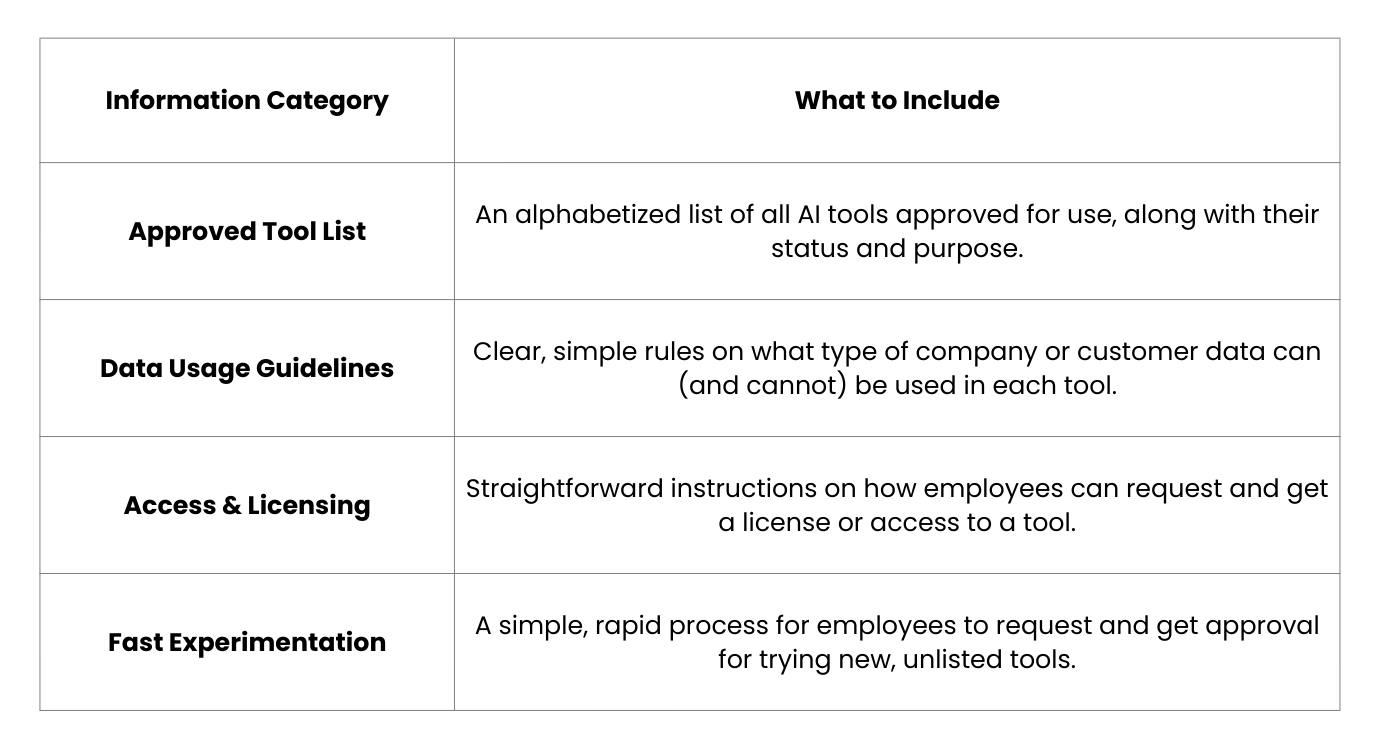
The Impact of Clarity
This single document is transformative. It eliminates fear and confusion, prevents risky "shadow IT" behavior, and empowers the entire organization to move fast and experiment confidently. It replaces uncertainty with a clear mandate: "Here is how you can safely innovate with AI."
By creating this "golden path," you've removed the final organizational barrier. You've not only enabled your colleagues but have also established the infrastructure for scaled innovation. With the system in place, the personal and professional rewards of your leadership become undeniable.
The Payoff: Why Being an AI Champion Is a Career Superpower
Taking the initiative to become your company's AI champion provides career benefits that extend far beyond your official job description. It's a role that offers outsized rewards for your proactive effort.
Unmatched Visibility Leading an AI transformation opens doors across the organization. You'll find yourself collaborating with senior leaders, being sought out by colleagues from different departments, and gaining a level of influence far beyond your scope and seniority.
Strategic Impact As an individual contributor, you can directly influence company strategy and the product roadmap. By demonstrating the practical value of new technologies, you can accelerate timelines for innovative projects and help shape the future of what your company builds.
Thought Leadership This work naturally positions you as an expert, both internally and externally. Colleagues will look to you for guidance, and you may find new opportunities to share your knowledge through platforms like company all-hands meetings or even industry podcasts.
Ultimately, this is a rare window of opportunity. As tech observers note, companies everywhere are racing to adopt AI and are looking for leaders to show them the way.
There's only one or two people who get to be the leader of this initiative. The first person to raise their hand gets this opportunity.
Your Turn to Lead
The path to becoming an AI Champion begins with a simple spark of curiosity and a willingness to share your vision. From there, it's about building momentum through hands-on learning, creating a safe path for others to follow, and ultimately, driving real organizational change.
This journey is available to anyone, regardless of their role or title. All it requires is initiative and a desire to help your team succeed in this new era. The playbook is here, now it's your turn to start.